



Traveling in a caravan has a particular charm. The freedom to move your home anywhere, wake up wherever the route takes you, and adapt your day to the
rhythm of the landscape.
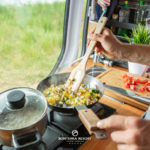
But if there is one moment that defines that lifestyle, it is the time to cook. In a small, and sometimes improvised, kitchen, every action counts: choosing what to bring, how to place everything, and how to prepare something delicious without creating chaos.
Far from being a limitation, this way of cooking invites you to return to the essentials: simple recipes, good ingredients, and tricks that make life easier.
Whether you are a weekend getaway enthusiast or embarking on a long trip along the Mediterranean, learning how to organize yourself in your motorhome
kitchen completely transforms your experience on the road.
To help you in this adventure, throughout this article, we will offer you practical and simple tips so that cooking in a caravan is not only comfortable but also
part of the enjoyment of the trip, especially if you are staying in a setting like Bonterra Resort, where that “slow” spirit that complements life in motion so well is breathed. Let’s get to it!
Cooking in a caravan: challenges and advantages compared to cooking at home
Someone new to caravanning often thinks that cooking away from home is a “reduced” version of what they would do in their usual kitchen. And yes, the space shrinks, the burners simplify, and the counter looks more like a board than a piece of furniture.
But cooking in a caravan also has its special touch. The smell of breakfast mixed with the campsite breeze, the barbecue shared with pitch neighbors, or the simple pleasure of preparing something delicious while the sun goes down behind the mountains.
Nevertheless, there are several challenges we must face, such as the lack of space, ensuring that the utensils fulfill multiple functions, and a rather compact pantry.
But those details cease to matter when we start cooking in a more creative, practical, and, above all, more enjoyable way. When every dish becomes part of the journey, the experience changes. From here, we can only encourage you to try it. You will love it!
Planning: the #1 trick for stress-free caravan cooking
Planning is the secret ingredient of any kitchen on wheels. You don’t need a millimeter-precise menu, but you do need to be clear about what you are going to cook, what tools you have, and how much space you have to store food.
Define your type of trip
Spending two nights at a campsite is not the same as traveling along the Mediterranean coast for two weeks.
- Short trips: comfort rules here. Bringing semi-prepared meals or very versatile ingredients removes a lot of mental load.
- Long weekends or 3–4 day getaways: enough to allow yourself to cook a little more, but without overfilling the pantry.
- Long routes: you need to think about preservation, variety, and purchases at the destination. Your menu must be flexible, capable of adapting to local
markets or unexpected events on the road.
Designing your menu according to the type of trip
A caravan menu works best if it follows three rules:
- Few ingredients, many combinations.
- Quick recipes that don’t consume too much gas or electricity.
- Dishes that can be adapted if you eat out one day or if you crave a local product.
Some practical ideas:
- Versatile bases: rice, short pasta, couscous, quinoa, omelets, vegetables that keep well (carrots, zucchini, onions, peppers).
- Easy proteins: eggs, canned cooked legumes, fresh cheese, chicken breasts or thin fillets that cook quickly.
- Extras that save any meal: nuts, cold sauces, cherry tomatoes, artisan or sourdough bread (lasts longer than sliced bread).
What to bring from home and what to buy at the destination
Bringing everything from home is tempting, but it is not practical. The ideal is to make a list of what should be brought from home and what should be bought once we are at our destination:
- Bring from home: spices, salt, oil, coffee, pasta, rice, nuts, small cans or jars, and a couple of wildcards like a jar of sofrito (sauce base) or tomato
sauce. - Buy at the destination: fresh fruit, vegetables, bread, meat, or fish. Buying fresh saves space in the fridge during the trip and allows you to support the
local economy.
What to buy at your destination
At our campsite, we have a supermarket right outside the premises that solves your daily needs without having to go far. It is ideal for restocking basics, buying fresh products, or getting products you forgot.
But if you want to give a special touch to your meals, local markets and shops are a treasure. Seasonal products, fresh fish, and fruits that truly taste like the Mediterranean. Plus, it’s an easy and pleasant way to integrate into the destination.
Basic equipment for cooking in a caravan (without filling the trunk)
Being able to cook well in a caravan does not depend on having a lot, but on having just the right things and choosing them well. A trunk full of “just in case”
only complicates our lives.
Heat sources: gas stove, induction, camping barbecue
Most caravans have a gas stove, perfect for quick, delicious, and reliable recipes. Some travelers also incorporate a small portable induction hob, ideal when you have access to electricity at the campsite.
And of course: the camping barbecue is a must. Not only for its flavor but also because it allows you to cook outside, without heating the interior of the caravan and without spending your own energy resources.
Minimum and multi-function kitchenware
To travel light but cook well, it is enough to have:
- 1 medium pot
- 1 frying pan
- 1 light grill pan (alternative to the frying pan if you prefer quick cooking)
- 1 good knife, but a really good one. One that counts for ten.
- 1 thin cutting board
- Stackable containers (tuppers), which also serve as bowls and plates
- A bottle opener and a peeler (yes, their absence hurts more than it seems)
How to organize the fridge and pantry so that everything fits and is visible
The trick is to organize like a smart Tetris:
- Group by families: breakfast, snacks, quick dinners.
- Avoid bulky packaging: transfer what you can to flat containers or zip bags.
- Place perishables in the front to avoid forgotten “surprises.”
- In the fridge, prioritize what truly needs to be cold; hard vegetables can be stored outside if it’s not too hot.
Order and organization in the caravan’s mini-kitchen
Organization is not a matter of aesthetic order, but a matter of culinary survival in small spaces.
Work areas: where to cut, where to cook, where to wash dishes
Designate a small space for each phase of cooking:
- Cutting area: thin and foldable board on any countertop.
- Cooking area: burners or hob, free of objects.
- Washing area: better to do it at the end of each meal to avoid accumulation.
This small “map” prevents chaos and speeds up preparation enormously. Try it and tell us how it goes!
Storage ideas: baskets, flat containers, hanging organizers
Hanging organizers are a brilliant invention for caravans, as they are light, take up no space, and keep spices, cutlery, and snacks visible. Stackable baskets
allow you to create levels inside small cabinets.
On the other hand, flat containers, rectangular tupper style, work magic in the fridge and pantry because they allow more things to fit and prevent items from falling out when opening the door.
How to save gas, electricity, and water when cooking in a caravan
In a caravan, every resource counts. Not due to limitation, but due to efficiency.
Tricks to spend less gas/electricity: use a lid, take advantage of residual heat
- Always cook with a lid: reduces cooking time and prevents heat loss.
- Turn off the heat a couple of minutes before finishing: the pot continues cooking by inertia.
- Do double cooking: if you boil rice, take advantage of the same heat for steamed vegetables.
- Opt for “quick” recipes: stir-fries, grilling, complete salads, or ready-in-1-minute quinoa jars.
How to wash dishes using little water and environmentally friendly products
- Use a spatula or paper to remove large residues before wetting.
- Fill one bowl with soapy water and another with clean water to rinse: you spend less than with the faucet running.
- Choose biodegradable soaps so as not to harm the campsite environment.
- Wash dishes right after cooking: grease is removed better and you consume fewer resources.
Where to shop and what to try if you come to Benicàssim with your caravan
A campsite in Benicàssim is the perfect destination for those who travel in a caravan and love to eat well. The mix of sea, market gardens, and local commerce makes cooking here an added pleasure of the trip.
Campsite super and local convenience stores for day-to-day needs
At Bonterra Resort, we have a small display of local products, and we also have a supermarket just a few minutes away, right outside our facilities.
In addition, the town’s shops broaden options, such as butcher shops, traditional bakeries, and small stores that allow you to buy just what you need without accumulating.
Markets and local products to give a “Mediterranean touch” to your recipes
If you come to Benicàssim, you cannot leave without first trying:
- Vegetables from the Castellón market garden: tomatoes that taste like tomatoes, cucumbers, eggplants, and bright peppers.
- Fresh fish from the Grao de Castellón fish market, perfect for grilling or cooking on the camping barbecue.
- Seasonal fruits: melon, watermelon, oranges, grapes.
- Local oils, cheeses, and wines that elevate any simple recipe.
A walk through the area’s markets turns any caravan menu into a small tribute to the Mediterranean.